| Delivery | Coverage | Pricing | Duration | KPIs |
|---|---|---|---|---|
| Managed field workforce | EN-IN, audio at drive-through and restaurant environments | Per session completed | Multi-day field execution | File pairing integrity, acoustic compliance, naming accuracy |
The Problem
Voice AI agents deployed into drive-thrus and other noisy commercial settings fail on data that never sounded like the environment they''re deployed into.
- Crowdsourced home recordings can''t reproduce a real environment. A recording from a quiet room has no way to approximate revving engines, ambient traffic, kitchen clatter, or the overlapping voices of a busy dining room.
- Ordering conversations are improvised around noise, not read from a script. A model trained on clean, rehearsed audio never learns what an actual customer sounds like fighting to be heard over a drive-through speaker.
- A single dropped or corrupted file breaks the whole diagnostic bundle. Signal processing analysis depends on every synced channel arriving intact. One missing file voids the session''s analytical value.
The Insight
Field-based, managed collection reaches conditions a distributed crowd never gets to. It keeps every file usable once it does.
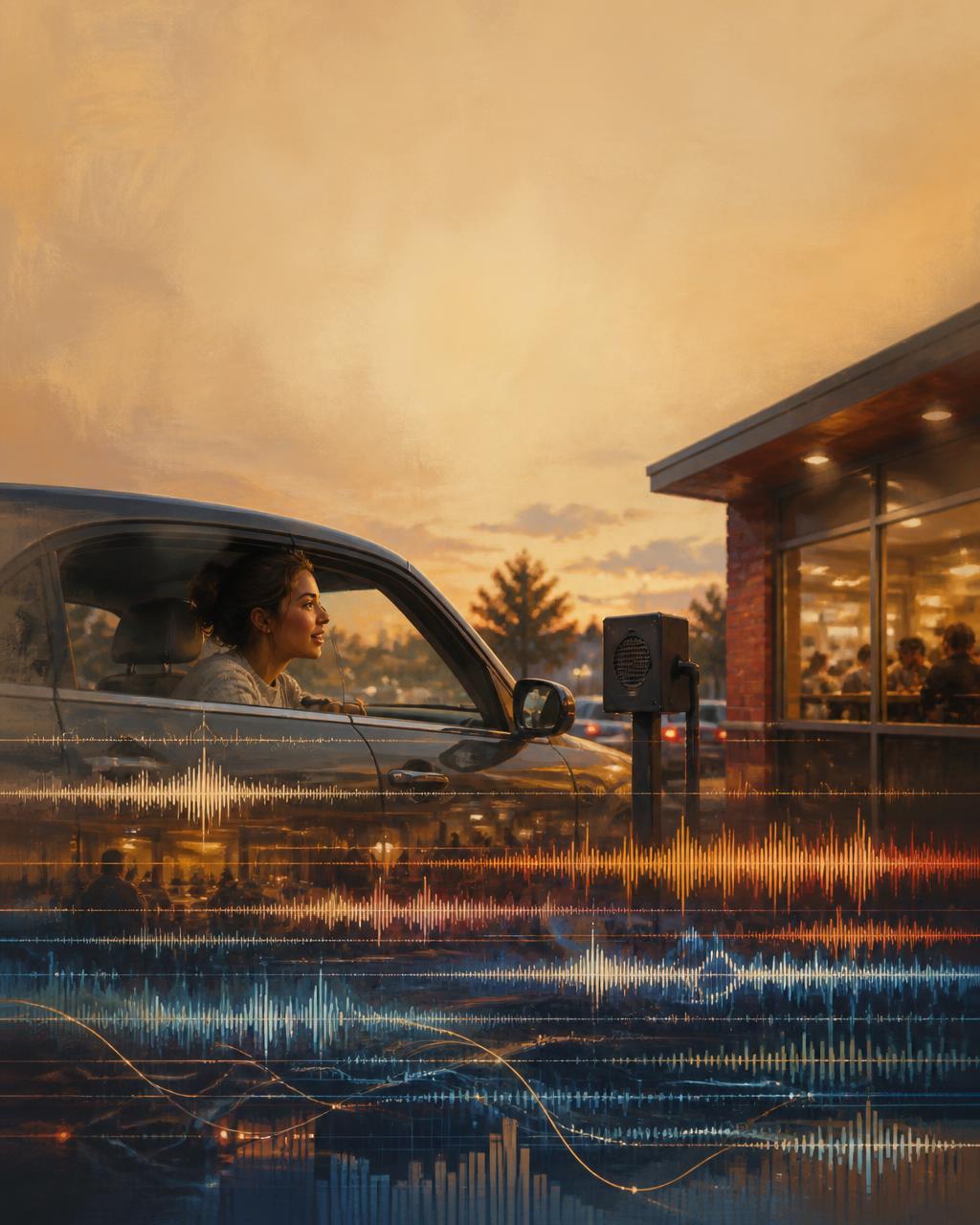
- Real acoustic environments have to be scouted, not simulated. Field workers selected parked-car locations by live traffic intensity and restaurant interiors by actual ambient noise level, verified against target acoustic profiles before a single session was recorded.
- Natural turn-taking comes from structure, not a script. Localized, recognizable menus gave workers a conversational frame with built-in pauses for where an AI agent would respond, while the wording itself stayed unscripted and improvised.
- A four-file bundle only has analytical value synced. Each session paired input audio, output audio, a secondary channel, and a WebRTC acoustic echo-cancellation log, files that are only useful to a signal processing team in perfect alignment with each other.
The Stakes
- A model trained on clean audio breaks the moment it meets a real drive-through. The gap between lab-quality training data and deployment conditions is exactly where voice agents fail once they''re live.
- An incomplete file bundle isn''t degraded data, it''s unusable data. Echo-cancellation and signal processing analysis require all four files per session. Missing one doesn''t weaken the dataset, it removes the session entirely.
- Unmanaged, home-based collection can''t guarantee any of this. A distributed crowd optimizes for convenience over acoustic authenticity, self-reports conditions nobody verifies, and delivers file sets nobody audits before they reach a client.
What We Built
- A managed field taskforce instead of a distributed crowd. Workers executed a strict, PM-designed diagnostic capture protocol on location, in real drive-through and restaurant environments, not from home.
- A dual-tool capture stack fit to the telemetry requirement. Workers ran native browser-level WebRTC diagnostic logging alongside a live audio channel, generating a four-file bundle per session: input audio, output audio, a secondary channel, and an acoustic echo-cancellation log.
- Environment scouting built into the workflow, not left to chance. Locations were selected and verified against target acoustic profiles, high or moderate traffic, high or moderate restaurant ambience, before recording began.
- A two-step audit before anything left the pipeline. Workers self-reviewed every recording immediately after the session. Every file set then went through full PM inspection before migration to client storage, with defects sent back for re-recording on the spot rather than delivered with a caveat.
- Strict technical prescreening to protect data integrity from the start. Workers were qualified on hardware, browser version, and a mandatory dual-tab setup check before being cleared to record a single session.
- Naming and inventory discipline built for a downstream team. Every file followed a fixed naming convention and was mapped against a client tracking ledger, so any session could be located without guesswork.
Why it Matters Now
- Conversational AI teams deploying voice agents into real commercial environments need training data that reflects the noise those agents will actually operate in, not a clean approximation of it. A managed field capture reaches that noise on purpose.
- Audio AI teams evaluating signal processing pipelines need synced, multi-channel diagnostic bundles. Not a single voice track with everything else inferred after the fact.
- Data operations leads comparing vendors get a workforce model built for field conditions from the outset. A managed taskforce executing a defined protocol produces audit-ready data that a distributed crowd recording from home cannot reliably match.
The order was never the hard part. Everything happening around it was.