
Why meaning matters for AI
LLMs trained only on raw text often produce plausible but incorrect interpretations. The result: outputs that sound convincing but fail to reflect reality.
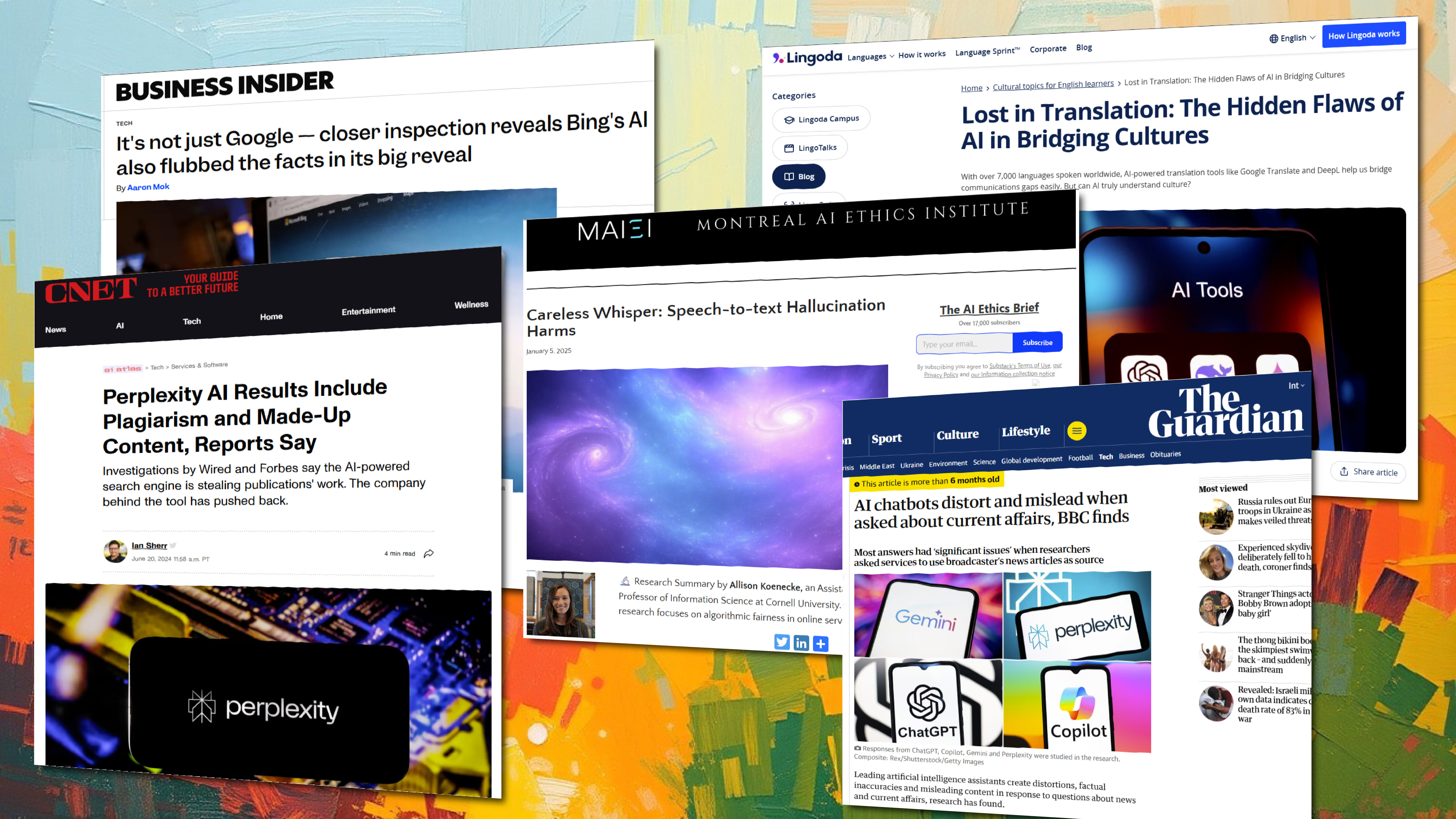
- Fact errors in practice: Microsoft Copilot and Gemini have both produced false or misleading statements on sensitive topics, from misreporting a rape case to incorrectly attributing health advice (The Guardian).
- Everyday misunderstandings: AI overview features have surfaced satirical content — such as an Onion joke about eating rocks — as genuine health advice (GeekWire).
When AI misses tone, emphasis, or structure, it can frustrate users, or worse, cause harm. Imagine a voice assistant that fails to distinguish between a polite suggestion and a firm command. Without grounding in linguistic nuance, trust quickly erodes.
The power of long-form transcription and diarization
Sigma’s Meaning workflows go beyond basic transcription. Our annotators segment audio into speaker turns (diarization), mark non-verbal events like laughter or hesitation, and anonymize sensitive data — all while following client-specific guidelines.
This level of precision also helps reduce well-documented issues in current speech systems. The Montreal AI Ethics Institute found that Whisper, a widely used transcription model, sometimes hallucinates entire sentences, particularly for speakers with language disorders, potentially reinforcing harmful associations (Montreal AI Ethics Institute).
By contrast, in one Sigma project for a multinational client, annotators processed hours of multi-speaker audio, labeling tonal shifts and acoustic events so the model could learn not just what was said, but how it was expressed. This ensures downstream systems can interpret meaning rather than surface sound.
From phonetics to intent: teaching nuance
Meaning is layered. Annotators label stress patterns, pauses, and intonation to show where emphasis falls in a sentence. They flag ambiguous phrases and provide clarifying context—teaching AI to distinguish between literal and implied meaning.
The importance of this work is clear when looking at translation tools. Dutch publisher VBK’s plan to use AI for literary translation has sparked concerns about nuance being lost, while Meta’s Ray-Ban glasses struggled with slang, turning the casual Spanish “no manches” (“no way”) into the nonsensical “no stain” (Lingoda).
Without human intervention, subtlety is lost.
Even in seemingly simple cases, models stumble. Business Insider reported Google’s AI confidently explained a made-up idiom — “You can’t lick a badger twice” — demonstrating how systems infer meaning from patterns rather than true understanding. And Bard, Google’s early conversational AI, misidentified a photo fact in its launch demo (PetaPixel), reinforcing how brittle surface-level training can be.
Why human-in-the-loop is essential
Across industries, failures underscore the need for human grounding:
- Bing’s chatbot demo produced entirely wrong answers on key queries (Business Insider).
Wired and Forbes accused Perplexity AI of using and misrepresenting their content without attribution, raising questions about accuracy and ethics (CNET).
These breakdowns are not just technical glitches; they are failures to capture context and meaning. Human annotators, by embedding linguistic, cultural, and semantic insight, prevent AI from projecting false authority or misleading users.
Translating nuance, tone and context for AI
AI can only approximate human understanding when trained on carefully annotated data that embeds nuance, tone, and context. Sigma’s Meaning workflows — spanning transcription, diarization, and semantic labeling — supply that missing layer of meaning.
If your AI only hears words, it’s missing the bigger picture. Download our free whitepaper, Beyond accuracy: The new standards for quality in human data annotation for gen AI, to learn how Sigma’s Meaning workflows bring true understanding to machine learning.